


“There Are Indeed Good Flower Seed Mixes on the Market”
Tholen – With undoubtedly the best of intentions, laws and regulations aim to make parks, field edges, road verges, and many other areas more bee-friendly. Municipalities, foundations, and even private individuals, also with the best of intentions, are motivated to contribute by buying flower seed mixes, sowing them, and thus trying to make bees happy. But, as it turns out, the quality often leaves much to be desired.
That, at least, is the result of research by Wageningen University, which confirms what’s been observed in practice. Take, for example, this item on RTV Oost, in which a reporter notes that there are hardly any flowers in her garden, and a biologist explains that this is because the flower mix she used contained very few flower seeds — but a lot of grass seeds instead. The mix was poorly suited to its intended purpose, and most of the flowers it did contain were exotic species — meaning plants that bees cannot use.
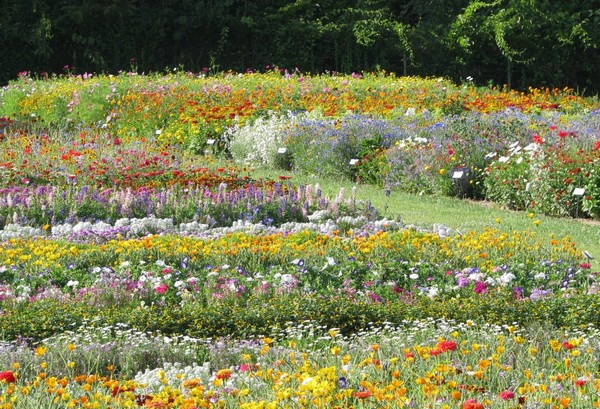
A Problematic Situation
And that’s a serious problem.
“First of all, such reports discourage people. They get the impression that their well-intentioned efforts to help pollinating insects have the opposite effect — because apparently there’s nothing good available on the market. Secondly, several companies, including ours, are being unfairly blamed,”
says Hans Veenstra of EconSeeds, a company that trades in flower seeds and is frustrated by this kind of publicity.
According to Hans, these reports overlook the real, underlying issue.
“If a mix that’s supposed to contain 30 different species turns out to have only five or six, that’s certainly worrying. But this has been going on for a long time. There are players on the market offering these kinds of mixes — and we, along with our competitors, regularly warn against them. Of course, these companies claim their mixes are diverse, and of course, anyone is free to test them. The point, however, is that these mixes are rarely sown in the Netherlands.”
Seeds Cost Money
The obvious question is why that is. The answer seems very Dutch: seeds cost money.
“In many countries — especially in France, but also in Switzerland, Germany, and several others — we hold a strong market position. People look at the research and decide what works and what doesn’t. We do the same. Based on market demand, our knowledge and experience, and solid scientific research, we create seed mixes that can be adjusted as needed. The costs of those mixes are accepted by customers because they’re tied to quality.
But here in the Netherlands, we often hit a wall. We constantly run into foundations that, when it comes down to it, go for a prescribed option — the cheapest one, or the most complicated one containing only so-called ‘native and local’ species.”
Not Native …
Mixes based on native species are often more expensive — partly because, Hans notes, people sometimes go too far in defining what “native” actually means.
“If a seed is grown abroad, it’s automatically labeled as non-native. The implication — perhaps unintended but quickly interpreted that way by the market — is that these species are therefore unsuitable for our insects. The truth is that many native species are simply cultivated elsewhere; and there are also species that, though not native, do extremely well here.
Take phacelia, for instance — a purple flower often seen along field edges. It’s not native, but it grows and blooms beautifully in the Netherlands, attracting swarms of bees.”
So, what exactly do we mean by “local” and “native”? What is the genetic difference between a bellflower from France and one from the Netherlands? And what is the real “gain” if that bellflower comes from the Netherlands instead of France?
“There’s a large number of standard cultivated varieties that, at the European level, differ little or not at all from specifically ‘local’ or ‘wild’ ones. This genetic pool forms a solid basis for seed mixes that can be safely and effectively used across Europe. These are mixes that definitely contribute to supporting pollinating insects.
If this knowledge were more widely shared, it would certainly ease the pressure on the availability of good and affordable seed mixes.”
… But Quality Should Come First
The discussion, Hans argues, should primarily focus on what constitutes a quality seed mix.
That a mix claiming 30 flower species actually consists mostly of five types of grass — and is therefore cheaper — is undeniable. That more diverse mixes are more expensive is only logical.
“But that’s not because certain species are native or not. These mixes are more expensive simply because they contain greater variety, and every species — native or not — needs to be produced and processed.”
The problem, and perhaps part of the solution, lies in the fact that there are no clear, verifiable quality standards for these mixes. It’s difficult to assess their origin and quality.
“Our company can supply just about anything,” Hans continues. “Almost all our products are grown by us, in all parts of the world. If a farmer or foundation needs any kind of mix, we can make it — or offer an acceptable alternative. So, it’s absolutely possible to use good mixes, but the customer must be aware of what they’re buying. The price naturally reflects the quality, effectiveness, and diversity of the mix — a cheap mix simply cannot deliver the same results as a more expensive one.”
A Pragmatic Approach
EconSeeds specifically focuses on these issues and seeks solutions that can genuinely improve biodiversity.
“If we in the Netherlands were willing to take a slightly more pragmatic approach to the use of species for biodiversity improvement,” Hans concludes,
“we could probably arrive at quality standards much faster. With those standards, both companies and individuals could verify the quality of the mixes themselves and regain the confidence that they are truly making a meaningful contribution to maintaining insect populations.”
Main source : https://www.biojournaal.nl/article/9235242/er-zijn-wel-degelijk-goede-bloemzaadmengsels-op-de-markt/